
 Through the IX Constitutional Government under Article 22 of Decree-Law No. 46/2023 of 28 July, Organic of the IX Constitutional Government, provides for the Ministry of Higher Education Science and Culture and establishes the Ministry referred to in accordance with Decree-Law No. 56/2023 of 6 September, Organic Ministry of Higher Education Science and Culture plays its important role as the government department responsible for higher education education and qualifications;
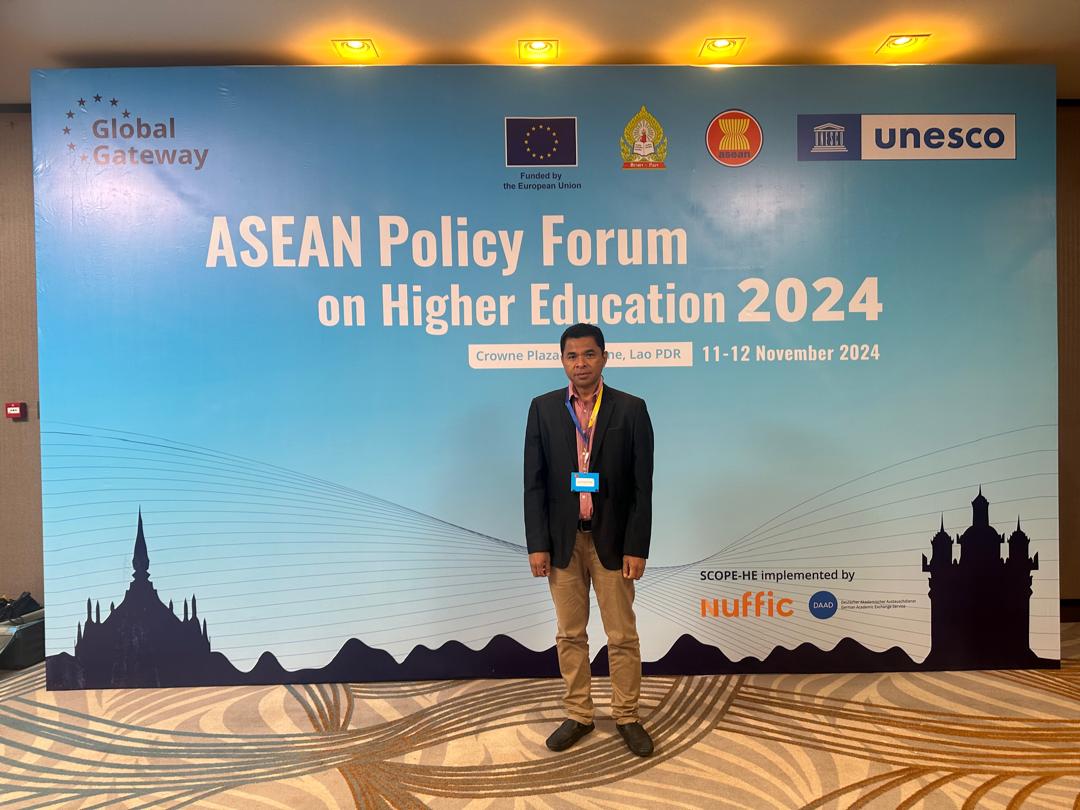
Chief Cabinet of the Ministry of Higher Education Science and Culture, participates in this activity of ASEAN Policy Forum talks about Higher education in ASIA, This activity : The ASEAN Policy Forum on Higher Education 2024 officially opened today at the Crowne Plaza Hotel in Vientiane, Lao PDR. The two-day event is hosted by the Ministry of Education and Sports of Lao PDR, in partnership with UNESCO and the EU-ASEAN Sustainable Connectivity Package – Higher Education Programme (SCOPE-HE), implemented by Nuffic and DAAD. Under the theme “Moving Higher Education Forward Together: Building Resilience and Flexibility by Connecting and Including All”, the forum gathers policymakers, academics, industry leaders, and international organisations from across the ASEAN region to foster collaboration and tackle the challenges facing higher education. With a focus on resilience, adaptability, and inclusivity, participants explored strategies to strengthen ASEAN higher education systems in response to rapid technological advancements, economic shifts, and environmental challenges.
The forum in Vientiane marks the beginning of an important series of policy dialogues, setting the stage for a progressive and sustained dialogue that will help ASEAN Member States and the EU work together towards building a more inclusive and connected higher education space. Over the next four years, six policy dialogues will be organised in ASEAN countries and Europe. These dialogues will cover key issues such as employability, digital skills, and sustainable education.
Why is the focus of today’s Forum so important? Quality higher education plays a critical role in shaping individuals and societies in today’s rapidly evolving world. It is a vital asset that fosters personal development and drives economic, technological, and social change. Educational attainment is particularly crucial for students from under- privileged backgrounds, offering them pathways to economic security and stable futures. Higher education institutions are also at the forefront of innovation and research, contributing signicantly to advancements in our societies. The climate crisis andCOVID-19 pandemic underscored the importance of these institutions in addressing global challenges through green and digital solutions, and breakthroughs in healthresearch.
The value of quality higher education in the modern world extends beyond individual benets, encompassing broader societal implications for the economy, social equity and innovation. And this is why investing in education in countries like Lao PDR is investing in human capital, assuring a more equitable and sustainable future for all in the country.
At the SDG Summit last year, the UN Secretary-General put forward six transitions that would have a catalytic and multiplier effect across all Sustainable Development Goals. Education is one of the six SDG transitions. Without a doubt, quality, inclusive and resilient education accelerates progress on all SDGs. This is not an option, it is an imperative. Building on what the esteemed speakers before me have said, I would like to share three reections that I hope will guide the Forum’s deliberations: First, in support of the Joint Declaration on the Common Space in South-East Asian Higher Education, investments are needed in quality higher education and evidence-based research. A stronger and harmonised higher education sector will catalyse the region’s economies, societies and cultures, bringing them closer to the vision of an ASEAN Community. Quality education also fosters a culture of inquiry and critical thinking that are essential for tackling complex issues, including the emerging challenges of frontier technology. Second, we must focus on ensuring equitable access to education for all youth and adults, especially those from marginalized and vulnerable groups. According to the International Labour Organisation, 20% of young women aged 15-24 years in the ASEAN region are not in employment, education or training, compared to 13% of young men. We cannot expect societies to ourish with such a stark disparity in place. Policy-based action to advance gender equality and equitable access is needed through scholarships and exible pathways to enter higher education, as well as ensuring lifelong learning opportunities for all. Third, there is a need to improve the relevance of higher education, especially in
terms of facilitating transitions to employment. Partnership with private sector can help inform curricular reforms and improve employability of graduates. Private sector can mentor students, join skills councils, and advise on competencies in demand. This is a win-win for education and businesses.
The United Nations in Lao PDR comprises 25 UN organizations working to support the achievement of the SDGs. This Policy Forum will help inform the UN’s strategies and partnerships in Lao PDR, drawing particularly on the regional and global expertise of UNESCO that has a unique mandate in helping countries achieve breakthroughs in SDG 4 on quality education.
These breakthroughs will not be possible without levelling the playing eld.Throughout ASEAN, we need more equity in access to higher education as part of a whole-of-society approach in order to promote economic, social and environmental impact for all. Together with ASEAN policymakers, youth, private sector, civil society, and development partners, the United Nations is committed to promoting equitable access and to advancing collaborative approaches to lifelong learning systems and future-facing skills development.